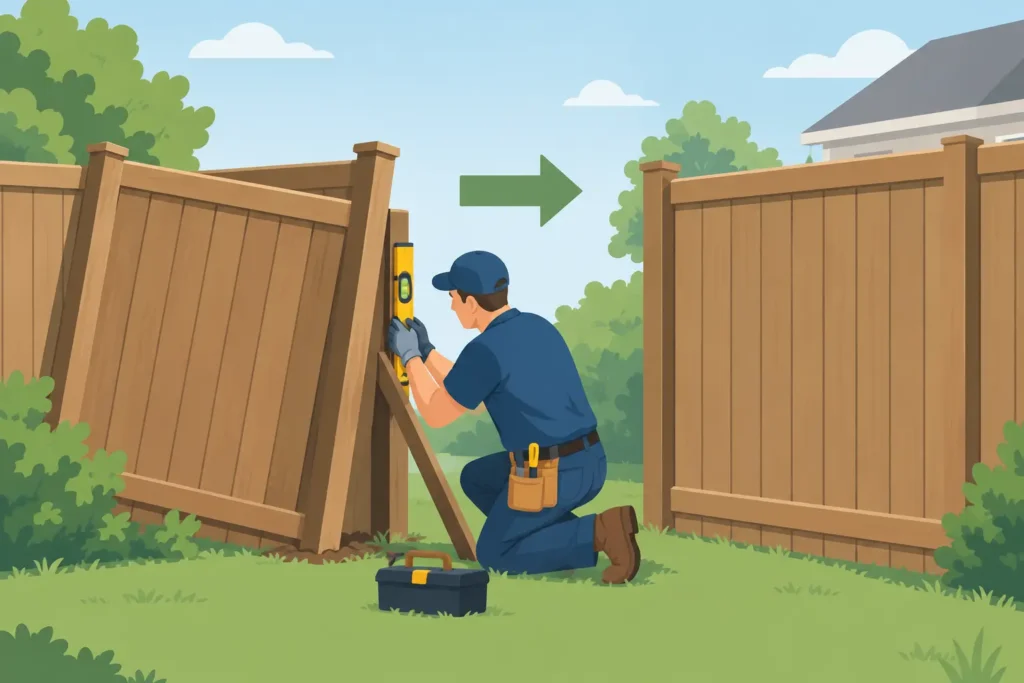
A fence rarely starts leaning because of one crooked panel. More often, the visible problem is the final sign of a weakened post, loose soil, failing fasteners, or a section that was never braced correctly. To fix leaning fence panels for the long term, start with the structure holding them up rather than pulling the panels straight and hoping they stay there.
In League City and nearby coastal communities, heavy rain, saturated ground, high humidity, and strong wind can all shorten the life of a fence that already has a weak point. A repair that addresses the cause can restore privacy, security, and curb appeal without replacing a fence that still has years of service left.
Find Out Why the Fence Is Leaning
Before removing boards or adding brackets, inspect the posts on both sides of the leaning section. If the panels are straight but the entire bay is tilted, the posts are the issue. If the posts remain plumb while individual rails or panels bow outward, the problem may be damaged rails, loose fasteners, or warped wood.
Walk along the fence line and look for movement at ground level. A post that rocks when pushed has likely lost support in its hole. Wood posts can rot below grade even when the exposed portion appears sound, while metal posts may bend at the base or pull loose from improperly compacted concrete.
Also look at the direction of the lean. A fence that tips consistently in one direction may be carrying wind pressure, especially if it is a tall privacy fence with little airflow. A single low spot can point to drainage problems or soil erosion. If gates drag, latch poorly, or pull on the adjoining fence section, the gate post may be transferring stress into the panels.
When You Can Fix Leaning Fence Panels Without Replacement
A targeted repair usually makes sense when the posts are solid, the wood has no significant rot, and the panels have only shifted because of loose hardware or modest rail damage. In this situation, carefully straightening the section and securing it with new exterior-rated screws, rail brackets, or replacement rails can be enough.
Start by supporting the leaning section with temporary braces. Use a level against the post and panel frame as you reposition it. Do not force badly warped wood into a perfectly straight line, since excessive pressure can split rails or crack older pickets. The goal is a stable, visually straight fence that can hold its position naturally.
Replace rusted nails with galvanized or coated exterior screws. Screws provide a stronger hold and make future maintenance easier. If the horizontal rails are split, soft, or sagging, replace them before reinstalling the panel. Attaching a sound panel to a failed rail only delays the next repair.
For a panel mounted between metal posts, inspect the brackets and fasteners closely. Loose panel brackets can allow a whole section to shift during a storm. Tightening or replacing the hardware may correct the problem, but bent posts should be evaluated separately. A bent metal post is not likely to become dependable again simply because the panel has been pulled straight.
Repairing Loose or Rotted Fence Posts
A loose post is the most common reason a fence leans. The right repair depends on the post material, its condition below grade, and the extent of the movement.
If a wood post is structurally sound but its concrete footing has shifted or loosened, it may be possible to brace the post upright, expose the surrounding soil, and reinforce the footing with fresh concrete. This approach works best when the old concrete is still stable and the post has no hidden decay. Allow the new concrete to cure before putting the fence section back under tension.
If the wood is rotted at or below the soil line, replacement is the better investment. Surface treatments and braces cannot restore the strength of decayed lumber. Remove the affected post, install a new pressure-treated post at the proper depth, and rebuild the rails and panels onto that stable support.
Post depth matters as much as the material. Taller privacy fences need deeper, properly sized footings because they catch more wind. Soil conditions also matter. Sandy or consistently wet ground may require a wider footing or a different installation approach than firm, well-drained soil. A contractor can assess these conditions before a small repair becomes a recurring problem.
Straighten the Fence Before Reattaching Panels
Once the weak post or rail has been repaired, use a level and a string line to align the fence section with the rest of the run. A string line is especially helpful on long property boundaries because a fence can look straight up close while gradually drifting out of line over several panels.
Reattach rails first, then secure the panels or pickets. Keep consistent spacing where possible, particularly on a privacy fence where uneven gaps are easy to notice. If prebuilt panels have become badly warped, replacing one or two panels may produce a cleaner result than trying to force damaged material back into place.
Leave a small gap between the bottom of wood fencing and the soil. Direct ground contact keeps the wood damp and encourages decay. Raising the fence slightly also makes it easier to spot erosion, insect damage, and drainage issues before they compromise the posts.
Do Not Ignore Drainage and Wind Pressure
A straightened fence can lean again if the site conditions remain unchanged. Water collecting along the fence line can soften the soil around posts and gradually move concrete footings. Downspouts that discharge directly beside a fence, low areas in the yard, and irrigation aimed at the posts are common trouble spots.
Correcting drainage may be as simple as extending a downspout, adjusting grading, or changing sprinkler direction. For more persistent water issues, a drainage solution may be needed before new posts are installed. It is better to address the ground first than to pay for repeated fence repairs.
Wind is another consideration for solid wood privacy fences. Houston-area storms can place substantial force on a long, unbroken fence run. Stronger posts, properly installed rails, quality fasteners, and well-built gates all help distribute that load. In exposed areas, a custom fence design may offer better durability than replacing panels one at a time.
Know When a Professional Repair Is the Better Choice
Some leaning fence problems are simple, but others involve structural work that benefits from experienced installation. Professional help is a smart choice when multiple posts are leaning, the fence borders a commercial property, the line includes a heavy gate, or the damage affects a shared property boundary. It is also worthwhile when rot has spread through several sections or when the fence has shifted after a major storm.
A contractor can determine whether selective repair is practical or whether replacement will provide better value. This is particularly useful for older fences where the visible leaning section is only the first failure. Replacing a few panels on a fence with failing posts throughout may look economical at first, yet it can lead to repeated service calls and mismatched materials.
Delta Fence and Construction approaches repairs with the same attention to alignment, materials, and long-term performance used in new fence construction. Whether the property needs a reinforced wood privacy fence, a repaired metal section, or a custom gate that no longer pulls on its posts, the goal is a secure boundary that looks intentional and performs reliably.
Prevent the Next Lean
Check your fence after periods of heavy rain and after strong winds. Catching a loose bracket, a wobbling post, or a developing low spot early is far easier than rebuilding a collapsed section. Keep vegetation trimmed away from the fence, avoid piling soil or mulch against wood posts, and make sure water does not drain directly along the line.
A fence should do more than stand upright for the moment. When posts are set correctly, panels are secured to solid rails, and water is directed away from the footings, the repair protects the appearance and function of the entire property for years to come.