A driveway gate usually becomes the first thing people notice about a property the moment they pull up. If it looks undersized, swings the wrong way, or struggles to open after a rain, the whole entrance feels like an afterthought. Custom driveway gate installation solves that problem by treating the gate as part security feature, part daily-use access point, and part architectural detail.
For homeowners, ranch owners, and commercial property managers, the right gate has to do more than look good from the street. It needs to fit the grade, match the fence line, handle the opening width, and hold up to constant use in real weather. A custom approach matters because no two properties have the same layout, traffic pattern, or design goals.
Why custom driveway gate installation matters
A prefabricated gate can work in limited situations, but many properties need something more precise. Driveway widths vary. Slopes change how a swing gate clears the ground. Some sites need wider access for trailers, work trucks, or equipment. Others need tighter control for family privacy or business entry.
Custom driveway gate installation gives you the ability to build around those conditions instead of forcing the property to work around a standard-size product. That affects performance just as much as appearance. A gate that is properly measured, fabricated, and installed is less likely to drag, sag, bind, or place excess stress on hinges and operators.
There is also the curb appeal factor. A driveway entrance sets expectations for the rest of the property. Clean lines, balanced proportions, and the right material choice can elevate a home or business frontage in a way that basic access hardware simply cannot.
Choosing the right gate style for the property
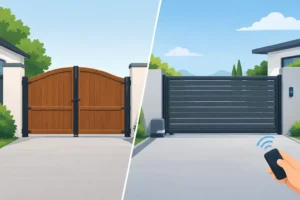
The best style depends on how the entrance is used day to day. Swing gates remain a popular option because they offer a classic look and can be built in single or double configurations. They work well when there is enough room for the gate to open fully and the driveway grade allows proper clearance.
Slide gates are often the better answer when space is tighter or the driveway rises too quickly for a swing gate. They also make sense for commercial sites that need wider openings and repeatable operation. The trade-off is that a slide system requires room along the fence line and more planning for track or cantilever support.
Material choice plays a major role too. Wrought iron and steel gates create a strong, high-end appearance and pair well with traditional and upscale properties. Aluminum offers a similar look with less weight and lower maintenance. Wood can create warmth and privacy, though it typically needs more upkeep over time. In some cases, combining materials gives the best result, especially when a property needs the strength of metal framing with the visual character of wood accents.
Design should match both function and architecture
A gate should feel like it belongs on the property, not like it was added later. The spacing of pickets, the height of the frame, decorative elements, and the finish all need to work with the surrounding fence, home exterior, or commercial façade.
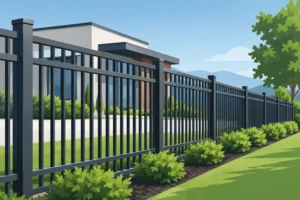
That does not always mean elaborate design. In many cases, the strongest result comes from simple proportions and durable construction. A clean powder-coated metal gate can look more refined than an ornate design that does not match the architecture. For ranch and larger residential properties, wider spans and heavier-duty frames may matter more than decorative details.
Privacy is another design decision that depends on priorities. An open-style gate improves visibility and can feel more inviting. A solid or semi-private design adds screening and a stronger sense of enclosure. Neither is automatically better. It depends on whether the property owner values visibility, privacy, ventilation, or a specific visual style.
What a proper installation includes
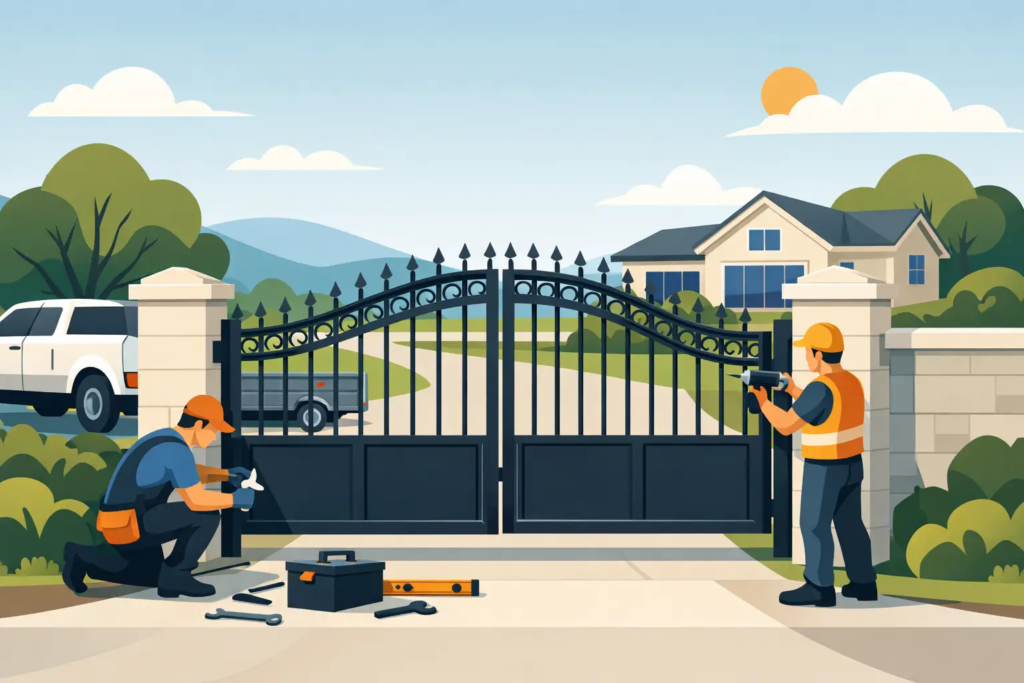
Good installation starts well before the gate is set in place. Site conditions need to be evaluated carefully, including slope, soil stability, drainage, utility locations, and available room for operation. Post placement and structural support are especially important because a driveway gate carries more load and movement than a standard walk gate.
The opening must be measured with precision. Even small errors can affect alignment, latch performance, automation, and long-term wear. If the gate is automated, power access and operator placement need to be planned at the same stage, not treated as an afterthought.
Fabrication quality matters just as much as field installation. Welds, joints, frame sizing, and finish protection all influence how well the gate performs over the years. On larger or heavier gates, underbuilding the frame to save cost usually shows up later as sagging, warping, or hardware failure.
A dependable contractor will also account for the way the gate is actually used. Daily family traffic, delivery access, livestock movement, employee entry, and after-hours security all place different demands on the system. The installation should reflect that reality.
Manual or automatic gate?
This is one of the biggest decisions in custom driveway gate installation, and the right answer depends on convenience, budget, and usage frequency. A manual gate can be a solid option for lower-traffic properties or secondary entrances. It has fewer components, lower upfront cost, and less to maintain.
An automatic gate offers a major convenience advantage, especially on busy residential driveways, private roads, commercial entrances, and properties where security control matters. Remote access, keypad entry, phone-based controls, and vehicle sensors can make daily use easier while also improving perimeter control.
Automation does add complexity. Motors, control systems, safety devices, and power needs must all be installed correctly. It also means maintenance should be taken seriously. If a gate will open and close many times a day, the operator should be sized for that workload rather than chosen on price alone.
Local conditions can affect long-term performance
In the Houston-area climate, moisture, heat, and shifting ground conditions can all influence gate performance over time. Metal components need protective finishes that can resist corrosion. Posts need to be set with enough structural integrity to handle movement and repeated use. Drainage around the gate area should not be ignored, especially where standing water can affect tracks, foundations, or operator equipment.
Wind exposure is another factor. A large solid-panel gate may provide excellent privacy, but it also catches more wind than an open-frame design. That can affect both hardware stress and operator performance. On some properties, adjusting the level of openness in the design creates a better long-term result without sacrificing appearance.
This is one reason local experience matters. A gate that looks good on paper still needs to perform in actual site conditions. Contractors who regularly work in League City, Friendswood, and Clear Lake understand how those conditions can shape design and installation decisions.
Common mistakes property owners should avoid
The biggest mistake is choosing a gate based on appearance alone. Looks matter, but they are only one part of the project. A beautiful gate that is too heavy for its hardware or poorly matched to the driveway layout will become a frustration fast.
Another common issue is underestimating clearance needs. Vehicles need room to approach, turn, and pass safely. Delivery trucks, trailers, and service vehicles often require more width than a passenger car. Planning only for current use can create limitations later.
It is also easy to overlook maintenance. Every gate system needs some level of upkeep, whether that means inspecting hinges, cleaning tracks, checking finishes, or servicing operators. The goal is not a zero-maintenance gate. The goal is a gate designed and installed to minimize avoidable problems.
What to expect from a quality contractor
A professional contractor should guide the project from site evaluation through design, fabrication, and installation with clear recommendations at each step. That includes helping you choose the right gate type, identifying structural requirements, and explaining where trade-offs exist.
For example, a heavier custom steel gate may offer strength and presence, but it will also demand stronger support and potentially a higher-capacity operator. A wood-faced gate may provide excellent privacy and warmth, but it may need more maintenance than powder-coated aluminum. Honest guidance matters more than a sales pitch.
Craftsmanship should show in the finished product, but also in the planning behind it. The best gate installations feel natural to use, fit the property cleanly, and continue operating the way they should after the newness wears off. That is the standard Delta Fence and Construction builds toward on every custom gate project.
A driveway gate is not just an entrance feature. It is a working part of your property that should make access easier, security stronger, and the overall appearance more complete. When the design is tailored to the site and the installation is handled with care, you end up with something that feels right every time it opens.